
 Agencies
  Contact-us
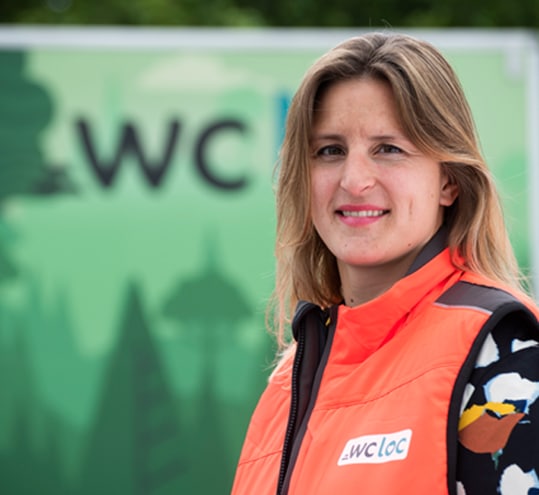
Interview with Faustine SCHOUTTETEN, Environmental Manager
Hello Faustine, tell us a bit about your background?
Hello, I’m 28, so a fairly short career path so far. I studied law and political science in Lille. Law interested me, but I didn’t want to take the bar exams. I discovered urban planning law during internships at a notary’s office, and since I was strongly interested in the environment, I went on to complete a master’s degree in urban planning, specializing in sustainable development. I worked as an HSE consultant at Veolia before joining Enygea.
And how exactly did you come to join Enygea?
I met Hervé Montagne in April 2016, as he wanted to know whether he should get into dry toilets. Following that meeting, he felt there might be a role to create — for launching this new product, but also and especially for waste management and formalizing agreements with wastewater treatment plants, a major issue for WC Loc.
So I started with a fixed-term contract, which then became a permanent position, with the goal in particular of pursuing ISO 9001 and ISO 14001 certifications.
It’s not common for an SME to have a dedicated environmental role, is it?
Hervé Montagne was indeed ahead of the curve on this. Waste treatment is a major issue at WC Loc, both environmentally and economically: for our Île-de-France branch alone, this treatment costs €90K a year!
We manage a very large volume of waste, since we empty the toilets across all our construction sites once a week, and we’re committed to doing things properly, even if it costs money.
Customers have also pushed us toward the environmental space through demand for dry toilets.
And yet, when people talk about your industry, they still talk about “chemical toilets”?
Back then, people called them chemical toilets because glutaraldehyde was used in the sanitizing concentrate instead of today’s blue product, and that ingredient really was chemical… But it disappeared more than 10 years ago!
The NF EN 16194 standard requires our sanitizing concentrate to remain active for at least 7 days: the product must maintain a consistent blue color (a natural dye) and neutralize odors throughout that period. It’s made of synthetic alcohol, methylene blue, and a synthetic fragrance; it’s biodegradable, and no substance in it is persistent. Its ecotoxicity is entirely negligible.
What’s more, it’s diluted: for one construction-site toilet over a week, we use a single dose of the blue product diluted in 19 liters of water.
“Likewise, our toilets use only 19L of water for 500 uses, versus 9 liters per flush for a household toilet. So our toilets really have nothing chemical about them!”
How are you received across the different departments and branches?
At first, the environment wasn’t the priority — teams were focused on operational emergencies.
But the certification challenge, along with the savings achieved through optimizing waste treatment, quickly gave me credibility. And our teams are very attentive to their customers: our sales staff were on the front line when it came to the growing demand for dry toilet solutions.
Relations are now very good — branch managers call me for advice, and I play a support role.
And environmental awareness is now well established throughout the company.
What are your plans for taking this approach even further? What’s the next step for Enygea?
The next big step will be moving from waste treatment to a virtuous cycle of waste reclamation! But for now, there’s a cultural barrier on this issue: we’re launching cow manure reclamation, but human waste is still taboo!
Urine makes an excellent fertilizer to replace chemical fertilizers. SIAAP (the Interdepartmental Syndicate for Sanitation of the Paris Metropolitan Area) is currently publishing a thesis on the subject, but we haven’t yet reached the stage of legal authorization.
That said, we’re anticipating this. Reclaiming what is currently, for us, waste should happen soon, so we’ve developed a module to separate urine from fecal matter. In any case, as soon as we get the green light, we’ll move forward!
We also want to become more self-sufficient in waste treatment: we’re going to build our own composting plant for dry toilet waste at our Verberie site in the Oise region.
At the same time, we’re testing an organic blue product: the classic blue product is already environmentally friendly, but we want to go even further. The cost will obviously be higher, but if the current trial across 4 branches proves successful, we’ll standardize the use of this product.
We also need to maintain our ISO 14001 certification and bring our entire ecosystem on board: subcontractors, suppliers, and other companies within the Enygea group as well.
We also have a full CSR approach. First, by staying attentive to employee wellbeing: for example, our support departments have just moved into an HQE-certified (high environmental quality) site in Englos (59).
But also, more broadly, by working toward sanitation access worldwide: we’ve been members of the Global Compact since March 2018, a United Nations initiative launched in 2000 to encourage companies around the world to adopt socially responsible practices by committing to integrate and promote several principles related to human rights, international labor standards, the environment, and the fight against corruption.

