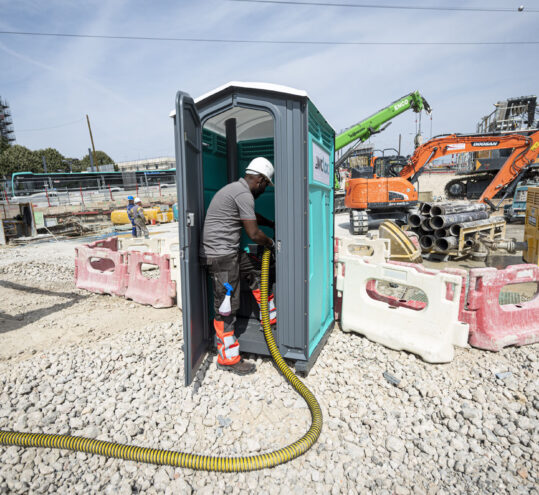
Under French labor law, employers are required to provide workers on construction sites with sanitary facilities compliant with articles R.4228-11 to R.4228-15. While these facilities are intended to ensure good working conditions for workers, they also help maintain overall hygiene and sanitation on the site. Self-contained recirculating toilets, dry toilets, connectable cabins with tanks, or mobile sanitation site facilities — WC Loc supports construction professionals with the delivery, installation, tank emptying, and collection of these units.
How Does a Self-Contained Construction Site Toilet Work?
Self-contained construction site toilets can take the form of an enclosed cabin and/or urinal, or can be combined with a changing room and break room as part of a construction site trailer, depending on the needs of the site’s workforce.
These units feature two separate tanks:
- a clean water tank that supplies the handwashing station
- a wastewater tank for effluent.
The effluent tank is fitted with a filter that retains solid matter. It’s primed with a biodegradable sanitizing solution that neutralizes odors. Combined with a pump, this recirculating tank feeds a closed-loop flush system.
What Are the Benefits of a Self-Contained Construction Site Toilet?
The main advantage of self-contained toilets is that they can be placed anywhere: since they don’t require connection to sewage, water, or electrical networks, they can be positioned right next to workers’ work areas on site (see the relevant article of the Labor Code on this point).
While a traditional flush uses an average of 7 liters of water per use, self-contained toilets use just 20L for 300 uses — only 0.06L per flush. By saving nearly 190L of water per week, the ecological impact of construction sites is significantly reduced.
These site installations are also very easy to move from one construction site to another. WC Loc has transport trucks fitted out with our partner Swittec, enabling the transport of site toilet cabins. For larger modules, a crane truck allows them to be loaded and installed at a new site.
Other connectable construction site toilet units are equipped with larger tanks built into suitable toilet cabins. These are recommended for medium- to long-duration construction sites. The tanks allow the units to function like self-contained toilets, but with a much larger water storage capacity. Connection is simplified thanks to installation fittings compatible with the pre-assembled cabins.
What Are the Regulations Around Construction Site Toilets?
On construction sites, the Labor Code requires every employer to provide workers with sanitary facilities. It specifies that when both male and female workers are present, separate sanitary facilities or distinct toilet use must be provided. Mixed-use self-contained toilets are therefore not permitted!
The Labor Code specifies the number of toilets required for workers:
- 1 urinal and 1 toilet for every 20 men,
- 2 toilets for every 20 women.
- At least one sanitary facility must include a handwashing station (article R4228-10).
How to Choose a Construction Site Toilet?
To choose a suitable self-contained toilet, it’s necessary to consider the needs and habits of the site’s workforce:
- We adjust the emptying frequency based on the number of people using the toilet; on a self-contained construction site toilet, the tank size is always the same.
- The number of users. It’s recommended to provide at least one self-contained toilet cabin per gender to ensure optimal comfort for all employees.

 Agencies
  Contact-us